Producers: Organisms, such as plants, that produce their own food are called autotrophs. The autotrophs, as mentioned before, convert inorganic compounds into organic compounds. They are called producers because all of the species of the ecosystem depend on them.
Consumers: All the organisms that cannot make their own food (and need producers) are called heterotrophs. In an ecosystem, heterotrophs are called consumers because they depend on others. They obtain food by eating other organisms. There are different levels of consumers.
This pyramid helps one visualize the fact that in an ecological system there need to be many producing organisms at the bottom of the pyramid to be able to sustain just a couple of organisms at the top.
The pyramid represents the decrease in the amount of energy, the number of organisms and the biomass from the producer to the high - order consumer levels.
Pyramid of Energy
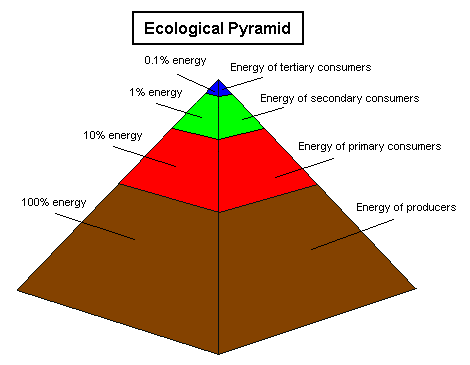
Much of the potential energy at each level never reaches the next level. Some of the energy that enters a food chain is used as each organism carries out its life functions (i.e. foraging, metabolic processes, reproduction, predator/prey behavior, and so on. Producers manufacture their own food source directly from sunlight by the process of photosynthesis. Consumers acquire energy through the ‘burning’ or breaking down of food molecules they consume (eat).
Pyramid of Numbers

The loss of energy at each trophic level also explains why there are usually fewer organisms in each higher trophic level. The total number of plants in a particular area would generally be higher than the number of herbivores that the plants support and the number of herbivores would be higher than the number of higher order carnivores.
Pyramid of Biomass

Biomass is the total mass of dry organic matter per unit of area. Each higher tropic level contains less biomass than the previous trophic level. Biomass is related to the abundance of organisms at each trophic level.
We did an experiment. That is concerned about ecological pyramid. We had human, wolves, snakes, mice, and decomposers. There are stations that you can get energy. By default, everyone can get one energy bar except decomposers. We can get only 3 energies each person. Human can only catch wolves, wolves can only catch snakes, snakes can only catch mice, and decomposers collect energy and put into stations. If someone caught by upper consumer, you have to give 1 energy bar to upper consumer. If you don’t have energy bar, you will be out. The time remit was 3 minutes.
First, we experimented by 1 wolf, 4 snakes, 6 mice, 2 decomposers, and 4 stations. The result was 1 wolf, and 4 mice survived. Second, we experimented by 3 wolves, 5 snakes, 3 mice, 2 decomposers, and 4 stations. The result was 3 wolves, 3 mice survived. Last, we experimented by 1 human, 1 wolf, 5 snakes, 5 mice, 2 decomposers, and 4 stations. The result was 1 human, 3 mice survived.


